
Read the case. Study the scene. Prove it.
Each case pairs a short written case file with a detailed picture of the scene. Students combine what they read with what they see, decide which clues matter, and defend what really happened.
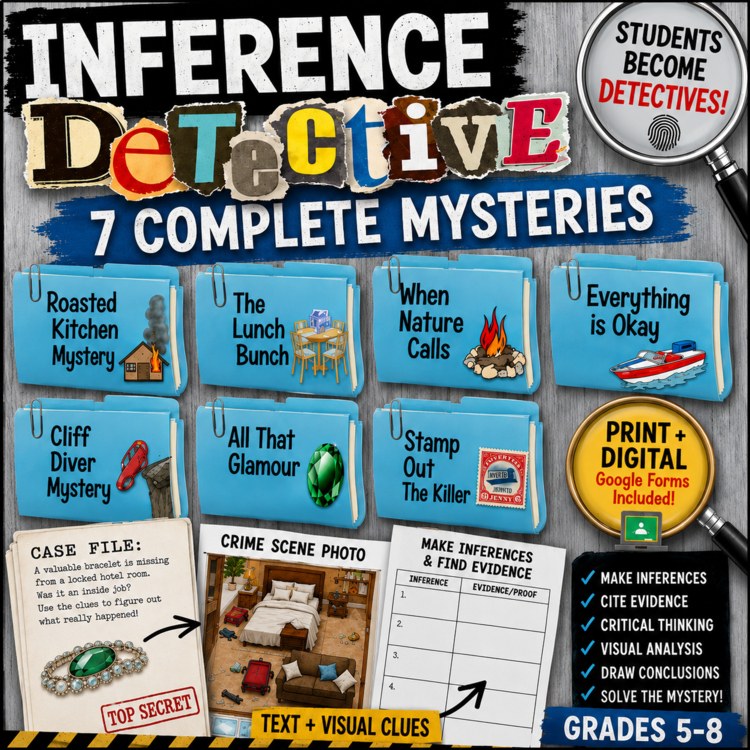
Read the case
A short scenario introduces the people, the events, and the details that might matter.
Investigate the scene
Students search the picture for evidence that connects to the case file.
Defend the inference
Questions build to one final conclusion, supported by evidence from both sources.
Two sources. One answer to prove.
Every mystery takes one or two class periods and works on its own, with partners, or in small groups. The same case comes three ways: a printable PDF, a self-grading Google Form, and a Boom Cards deck.
- 33 mysteries for Grades 5–8, plus 10 Junior Detective cases for Grades 4–6
- Printable, Google Forms, and Boom Cards versions of each case
- Answer keys and a final question that asks students to explain what happened
A few useful details.
How is this different from the Reading Mysteries?
Inference Detective is a short whodunit: one case file, one picture, one or two periods. The Reading Mysteries are full science and social studies reading systems with passages, a five-skill diagnostic, and a case file that runs across several days.
Which bundle should I start with?
Most teachers start with the 7 Detective Mysteries for Grades 5–8. The 10 Junior Detective Mysteries fit Grades 4–6, and the 33-mystery bundle collects everything.
Do students need accounts for the digital versions?
Google Forms open in any browser with a Google login, and Boom Cards run in a free Boom Learning account. The PDF needs nothing at all.
One topic. Three ways in.
Try A Cooler Schoolyard, a Grade 5 Read Together lesson with three reading versions and one shared decision.
Plus occasional teaching ideas and MyPaths updates.